Procurement note
Yale YK Hoist Control and Mobile Drive Monitoring Options
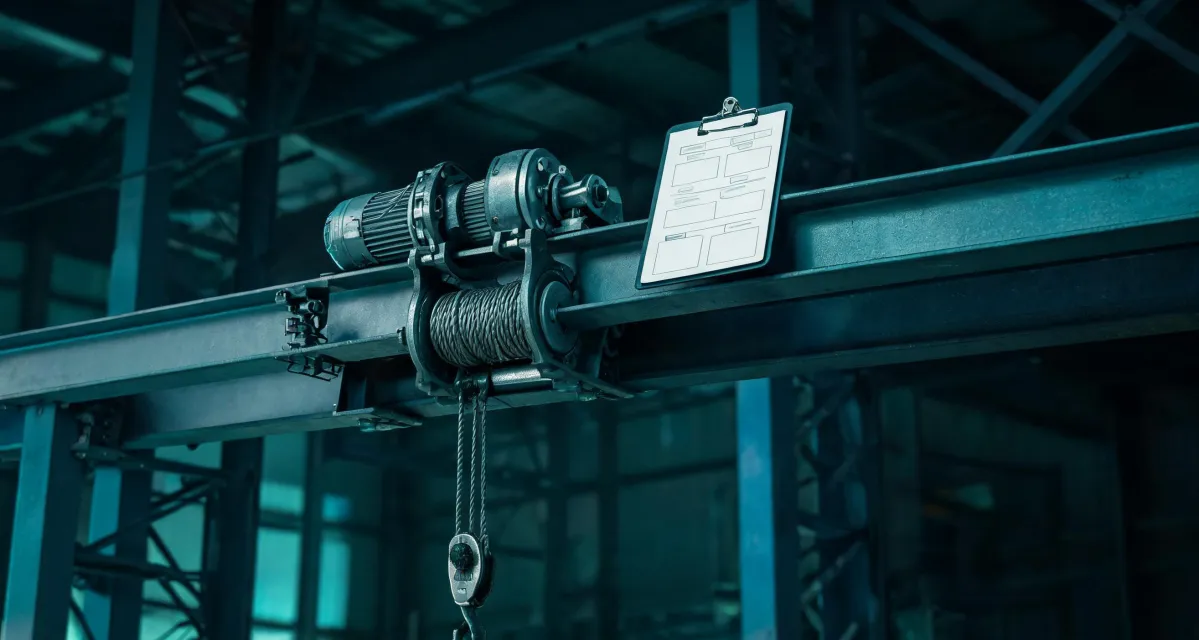
What control and mobile drive monitoring options does a wire rope hoist supplier actually offer on a Yale YK? The Yale YK comes in three control configurations — 2-speed, open loop vector, and closed loop vector — plus an optional Intelli-Connect Mobile package built around a WOP-20 module that connects to one Magnetek VFD. The useful question is not which option sounds most advanced. It is which control tier matches the load-handling job, and what the mobile monitoring module can and cannot see.
This article stays inside the Yale YK brochure scope. It does not treat the options as a universal wire-rope-hoist menu, and it does not turn a monitoring add-on into remote control or plant-wide analytics. The framework is simple: choose control first, monitoring second. Each tier answers a different question about speed range, feedback, and positioning, so the right choice depends on the lift, not on a feature count.
Three Control Tiers, One Starting Framework
The Yale YK brochure lists three hoist control configurations: 2-speed, open loop vector, and closed loop vector. They are not interchangeable trim levels. Each one targets a different operating problem: basic two-speed duty, feedback-based monitoring, and precision positioning. That is the starting map, and the sections below take each tier in turn.
The 2-speed configuration is the base choice. It is the tier to start with when the lift needs two clear speeds and nothing more from the control package. Its speed range and panel arrangement are the first practical details to check.
Open loop vector, or OLV, is the feedback tier. It is aimed at monitoring rather than basic two-speed duty, and it sits between the base tier and the precision tier in the brochure's control map.
Closed loop vector, or CLV, is the precision tier. It is the option to examine when the lift needs more than two-speed duty or encoder feedback, and the later section explains what the brochure actually assigns to it.
The relationship is easier to hold if you separate control from monitoring. 2-speed, OLV, and CLV are control configurations. Intelli-Connect Mobile is an optional monitoring, analytics, and configuration package. A buyer who treats the mobile app as a fourth control tier will misread both the quote and the scope.
The three-tier map is useful because it prevents a common buying error: comparing options by feature count instead of by the job. A 2-speed quote, an OLV quote, and a CLV quote can all be Yale YK and still differ in speed range, feedback, and positioning. The tier names tell you which question to ask first.
What a 2-Speed Control Actually Changes
On the Yale YK, 2-speed is not only a label for slow and fast. The brochure ties it to a standard 6:1 turndown and a control panel mounted to the gearbox. Those two details matter because they set the speed range and the physical placement of the panel.
That placement is a real selection difference. The brochure does not describe every Yale YK control package as a gearbox-mounted panel; the OLV section uses a different housing arrangement. If your planning assumes every control package looks the same on the hoist, the 2-speed description corrects that assumption.
The trade-off is straightforward. A 2-speed configuration gives you a defined two-speed duty and a simpler control arrangement. It does not add the gearbox encoder feedback that the brochure associates with OLV, and it does not target the micro-positioning language used for CLV. If your lifting routine is basic two-speed handling and you do not need direction or overspeed feedback, go with 2-speed and skip the extra feedback layer. If those feedback signals are part of the job, the base tier is the wrong place to stop.
This is also where model scope matters. The 6:1 turndown and gearbox-mounted panel are Yale YK brochure statements, not a blanket rule for every wire rope hoist on the market. A quote for another model needs its own confirmation.
Open Loop Vector Adds Encoder Monitoring
OLV is the middle tier, but it is not a vague middle. The brochure gives OLV two concrete pieces: controls in a separate NEMA-rated enclosure mounted to underhung hoists, and an encoder mounted to the gearbox for direction and overspeed detection. Those pieces explain why OLV sits above 2-speed in the control map.
The enclosure detail is practical. The brochure says the enclosure is shipped loose for the greatest flexibility in top-running double-girder and base-mount configurations. That means the control package is not always a fixed, hoist-mounted box. The mounting arrangement can change with the crane or hoist configuration, and that change belongs in the procurement conversation.
The encoder is the feedback layer. Those two signals are monitoring functions, not the same thing as micro-positioning. The brochure frames the encoder as improving the safe operation of the wire rope hoist. Keep that wording at the level the brochure supports: it is an added detection capability, not a substitute for the model-specific manual or a site-specific risk review.
If that feedback is the gap you are trying to close, go with OLV rather than 2-speed. The trade-off is more hardware and configuration to confirm: separate enclosure, mounting arrangement, encoder location, and the exact model. If those signals are not part of the job, the extra layer may be complexity you do not need.
Closed Loop Vector and Its Precision Tradeoff
CLV is the tier to examine when the load has to arrive with control, not just speed. The brochure says CLV configurations offer the greatest positional accuracy. It ties that to variable speed control, micro-positioning, precision load control, and a decrease in load bounce and swing.
The brochure also gives CLV a 10:1 speed control and the ability to float the load with full torque at 0 rpm. Those are the details that separate CLV from OLV in the brochure. They point to low-speed control and load holding, not simply a wider speed range for its own sake.
The hardware story follows the same pattern. Encoders for CLV hoists are contained within the motor, and CLV control enclosures are mounted in the same manner as OLV hoists. So the enclosure logic carries over, while the encoder location changes. A buyer comparing OLV and CLV should ask where the encoder sits and how the enclosure is mounted, because the brochure draws those distinctions.
Imagine a bay where the operator has to bring a load down to a mark and hold it steady while a second person aligns it. That is the kind of job where the brochure's micro-positioning and low-speed load-control language becomes relevant. It is also the kind of job where a 2-speed package and a CLV package should not be priced as if they were the same control tier.
Here is the trade-off. CLV gives you the precision tier, with the positional accuracy and low-speed control the brochure assigns to it. It also brings more feedback and configuration burden than a 2-speed package. That burden is not a defect; it is the price of the precision tier. If the lift does not need that level of positioning control, CLV may be more control than the job justifies. If it does, the simpler tiers are not equivalent substitutes.
What Intelli-Connect Mobile Can and Cannot See
Intelli-Connect Mobile is a separate option, not a control configuration. The brochure describes it as wireless drive monitoring, analytics, and configuration. The package includes a wireless operator module, WOP-20, mounted on the control panel. That module connects to a single Magnetek VFD via an Ethernet cable and creates a Wi-Fi network. A personal electronic device, such as a smartphone or tablet, reaches that network through the Intelli-Connect Mobile app.
The boundary is in the word single. The WOP-20 connects to one Magnetek VFD. That makes the package a local drive-monitoring and configuration tool, not a plant-wide analytics platform and not a remote hoist control. The brochure language is monitoring, analytics, and configuration; it does not describe this module as a radio remote for the hoist.
The module also does not turn a smartphone into a hoist controller. The brochure describes access to drive monitoring, analytics, and configuration through the app. If your team expects the phone to replace the pendant or radio remote, that expectation is outside the module's described scope.
That distinction changes the buying decision. If you want phone-based visibility and configuration access for one Magnetek VFD, add Intelli-Connect Mobile and confirm that the hoist is ordered with the option. If you expect the module by itself to give you fleet-wide visibility across multiple drives, skip it for that purpose. The trade-off is convenience at one drive against scope across many drives.
Availability is configuration-specific. The brochure presents Intelli-Connect Mobile as an option on the Yale YK, so the quote needs to confirm the WOP-20, the VFD count, and the app access rather than assuming every YK quote includes them.
Choose Control First, Monitoring Second
Run the decision in order. If basic two-speed lifting is enough and you do not need encoder feedback, go with 2-speed. If direction and overspeed feedback or a separately housed control package matters for your configuration, go with OLV. If the load has to land dead-on, go CLV. That precision is not free, because the added feedback and configuration work is the price. If phone-based monitoring and configuration of one Magnetek VFD is the job, add Intelli-Connect Mobile; skip it if you expect multi-drive fleet visibility from this module alone.
Suppose a maintenance team is replacing an existing hoist and wants fewer surprises at commissioning. The useful quote questions are concrete: Which Yale YK model and control configuration is being quoted? Is the panel gearbox-mounted or is the control package in a separate NEMA-rated enclosure? For OLV or CLV, where is the encoder located? For CLV, is the 10:1 speed control and 0 rpm full-torque float part of the quoted configuration? For Intelli-Connect Mobile, how many Magnetek VFDs does the WOP-20 connect to? These questions do not add a new specification; they force the brochure details into the quote.
The plain trade-off is this. You gain simplicity with 2-speed, feedback with OLV, and precision with CLV. You give up the feedback layer at 2-speed, the micro-positioning tier at OLV, and some simplicity at CLV. Add Intelli-Connect Mobile and you gain phone-based monitoring and configuration for one drive; you give up any expectation of whole-fleet visibility from that module alone. Choose the control tier for the lift, then decide whether the monitoring scope is worth adding.
Share this note with the buyer team that writes the next factory request.

Jane Smith
I’m Jane Smith, a senior content writer with over 15 years of experience in the packaging and printing industry. I specialize in writing about the latest trends, technologies, and best practices in packaging design, sustainability, and printing techniques. My goal is to help businesses understand complex printing processes and design solutions that enhance both product packaging and brand visibility.
Comment collection is not enabled. Use the inquiry form for procurement questions.