Procurement note
Wire Rope Hoist Supplier Duty Classification: A Cited Model Example
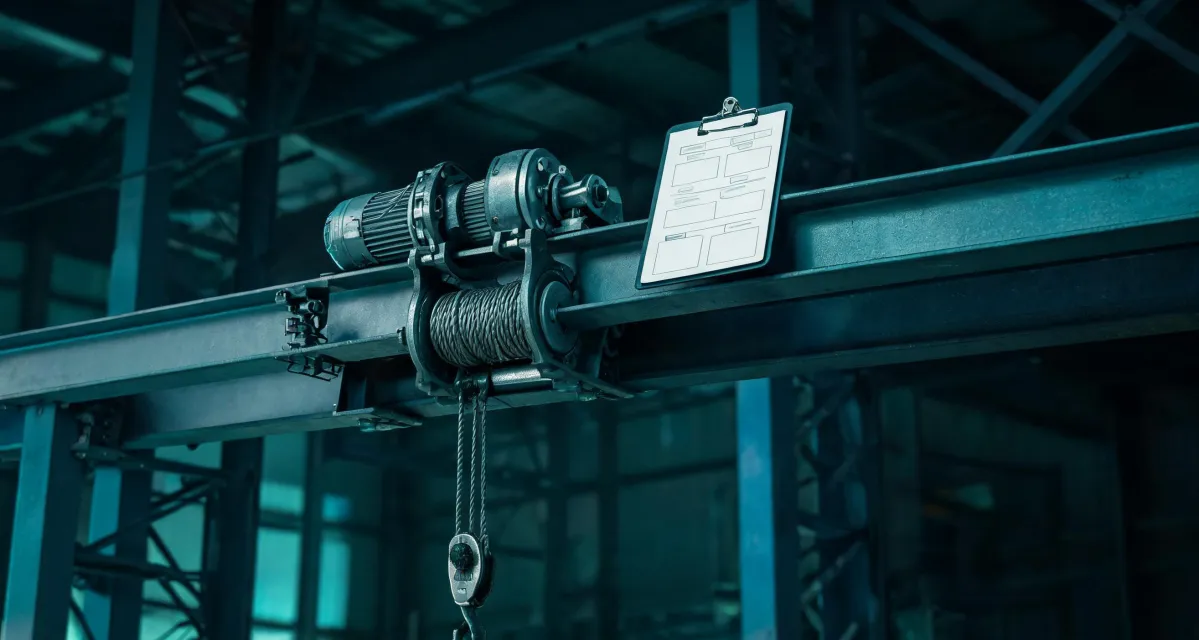
A wire rope hoist supplier's duty classification information is a rating of the hoist as a mechanism, computed under one named standard from two inputs you provide: how long the mechanism is in motion, and the load spectrum. The Yale Global King manual used as the example here ties its rating to FEM rules for the design of serial lifting equipment and to that specific model line, so treat the number as an output of a calculation rather than a grade you can rank across catalogs. Strip away the model name and the standard and the letter means nothing.
Get all four pieces on the table — the standard, the model, the operating time and the load spectrum — and a duty class describes your own operation. Miss any of them and you are reading a number that describes someone else's warehouse.
Duty Class Rests on Two Inputs
FEM treats this hoist as a mechanism rather than a catalog item, and it classifies mechanisms by two factors: class of operating time and load spectrum. The manual puts a condition ahead of any class: your application must be definable by those two factors in order for a duty classification to be determined. That condition is the whole framework in one line.
Because the class sits at the end of that calculation, the same hoist can land in two different classes depending on what the buyer describes. A supplier who asks how long the hoist is actually moving, how many lifts your day holds, and what those loads weigh is doing the classification work. A supplier who asks nothing and still quotes a class has either assumed your application or copied a class from somewhere else, and neither answer describes your building.
Keep the division of labor straight: the standard sets the method, the model sets what was built and rated to that method, and your operation supplies the number that lands in the class. Change any one of the three and the label on the quote changes with it.
Prepare the two inputs and the conversation gets short.
Operating Time Counts Only Time in Motion
Class of operating time indicates the average period per day during which the mechanism is in operation, which the manual defines as anytime the equipment is in motion. Not the length of the shift, not the hours the dock is open, not the time a load hangs on the hook while the operator checks a label.
Count only hoisting and lowering and you will undercount, because the manual's definition covers any time the equipment is in motion, travel included. A hoist that lifts rarely but travels constantly is still accumulating operating time, which means the bridge and trolley movements belong in your figure.
The manual determines that class by calculating average daily operating time, or average daily use, and this is the number applications most often overstate. A hoist typically stands still far longer than it moves, so the figure the class responds to is hours of motion, meaning hoisting, lowering and travel while the mechanism runs, not the span of the shift it hangs in.
Because the count is motion rather than attendance, a two-shift warehouse that lifts intermittently can land in a lower operating time class than a single-shift cell that runs its hoist near-continuously. The longer shift does not automatically carry the heavier class. That inversion is why a shift count makes a bad opening answer to a supplier's first question.
You do not need a stopwatch study to get this right. Walk the duty cycle as the hoist actually lives it, count the minutes it is moving across a representative day, and write down what you counted, because the supplier has to apply the same definition you did or the two numbers never meet.
Load Spectrum Changes What the Hours Mean
Identical motion hours do not produce identical classes. The second factor is what separates them.
Load spectrum is the factor the manual names next to operating time, and it is the one buyers leave out. Because a mechanism accumulates damage from the stress each cycle carries and not from the count of cycles alone, a day of light lifts and a day of the same number of near-capacity lifts are not the same day to the hoist. The reason comes down to fatigue: loads close to capacity consume the working life of the structure faster than the same number of light loads, which means two warehouses can show matching hours on the meter while deserving different classes. That is why the manual asks for both factors together, one describing exposure in time and the other describing exposure in stress, neither standing alone. Hours without a load mix are half an input.
So the load mix conversation belongs before the model number, not after it.
A Higher Duty Class Is Not Automatically Safer
A higher class is not a safety margin you buy up at the end of the quote. It is the label that came out of your own two inputs, and choosing a heavier one to feel covered substitutes a conclusion for the calculation that produces it.
The same caution runs across standards. The classifications in this legacy FEM manual are separate from other classification systems, so a class letter on one sheet and a number on another do not convert by eye. Which means a comparison across catalogs has to start with the standard's name and version, because the labels themselves are not a shared scale.
Over-classing is not free either. A heavier class has to come from somewhere in the mechanism, and whatever it costs shows up in the price and in the structure above the hoist. Ask what physically changes as the class moves up, whether frame, gearing, motor or brake, and what those changes do to headroom, weight on the runway and your parts routine. If the answer is that nothing changes and it is simply a better class, the label is decoration.
Understating is the quieter mistake. A class built on optimistic motion hours or a load mix that ignores the heavy lifts does not announce itself at commissioning; it shows up as wear and unplanned downtime later, when the maintenance budget has already been set. Neither error is visible on the delivery paperwork.
Reading the Duty Label on a US Spec Sheet
Treat a quoted class as a four-part record: the standard it was assigned under, the model it was assigned to, the operating time used, and the load spectrum used. The Yale Global King manual earns its place as an example because it states its basis, a specific duty classification described by FEM rules for serial lifting equipment, and ties that classification to a named hoist line. A bare letter on a submittal sheet does neither.
Ask which standard the class was assigned under, and which model it applies to. Then get the two inputs in your own units rather than the catalog's: how much of the day the hoist is in motion, and what mix of loads it carries. Finally, ask how their class maps to a different system when the project specifies one, and put the answer in writing with a model number attached.
In a US project this question tends to surface twice, once when the crane is specified and again when the submittal is reviewed. If the class arrives at the second step with no standard beside it, the review has nothing to check it against and the conversation restarts at the worst possible moment.
None of this asks you to run the calculation yourself. It asks the supplier to show the inputs, because a class without them cannot be checked by anyone at the table, including the person who quoted it.
Two Shifts, One Hoist, Two Inputs to Describe
Consider a warehouse running two shifts on one bridge crane, lifting concentrated in receiving and shipping, mostly medium loads with an occasional load near capacity. Nothing in that picture is a measurement; it is the shape of the answer a supplier needs before any class can be assigned.
The operating time answer is not the shift length. The manual counts the average period per day the mechanism is in motion, so the honest figure sums hoisting, lowering and travel across the day and averages it. Suppose that sum comes to two or three hours across both shifts. Report that number together with how you counted it, so the supplier can see whether your definition matches theirs.
The load spectrum answer is the mix: what share of lifts is light, what share lands near rated capacity, and how often the heavy ones come through. Describe the worst week rather than the average week, because the class has to cover the working life, and the easy weeks do not set the exposure.
If the supplier's method subtracts breaks or counts only loaded hoisting, your figure and their figure are not measuring the same thing. Make them state the definition in the same breath as the number.
Two inputs in your own units produce a class that belongs to your building.
When a Duty Class Cannot Answer Your Question
A single-model manual gives the method and the definitions of both inputs. It does not hand over a universal grading table, and it does not convert its classes into another system's. Those gaps close with the supplier's data sheet and a stated basis for the class, not with a number you guessed to fill the space.
If your site runs one shift, lifts a fixed load and you are replacing an identical hoist, the class on the old unit's nameplate is a better answer than any new analysis, and this way of reading a quote is work you do not need. If your real cycles differ from the catalog assumptions, or a supplier has handed you a class with no standard and no inputs beside it, ask for the two inputs and the standard before price and lead time enter the conversation.
Share this note with the buyer team that writes the next factory request.

Jane Smith
I’m Jane Smith, a senior content writer with over 15 years of experience in the packaging and printing industry. I specialize in writing about the latest trends, technologies, and best practices in packaging design, sustainability, and printing techniques. My goal is to help businesses understand complex printing processes and design solutions that enhance both product packaging and brand visibility.
Comment collection is not enabled. Use the inquiry form for procurement questions.