Procurement note
Monorail and Double Girder Options From a Wire Rope Hoist Supplier
-
Why a Tonnage Range Fails as a Starting Point
-
The Four Arrangements, as Published
-
Headroom and Hook Approach Come First
-
Where the Monorail Ladder Breaks
-
Beam Fit and the Two-Speed Trolley
-
When a Base Mount Beats a Trolley
-
A Tight-Headroom Bay, Walked Through
-
Run the Checks in This Order
-
What to Confirm Before You Specify
The expensive mistake in this category is quoting by tonnage. A maintenance lead emails a supplier with a tonnage and asks for a price, gets a top-running double-girder sheet back, and only when someone walks the bay with a tape does the problem surface: the hook cannot reach the pick point, or the beam under the runway is not a beam that trolley was built to sit on. Nothing about the tonnage was wrong. The shape of the machine was.
The arrangements a supplier actually publishes are not interchangeable packaging around one hoist. In the Yale YK line, and this applies to those published configurations rather than to every wire rope hoist on the US market, the brochure names four formats: a low-headroom monorail trolley, a standard-headroom monorail trolley, a top-running double-girder unit, and a base mount. Each one carries its own stated capacity span. That is the single fact most early RFQs get wrong: the span belongs to the arrangement, not to the product family.
Why a Tonnage Range Fails as a Starting Point
Put the four spans side by side and the trouble is plain. The top-running double-girder unit and the base mount are both listed at 1–55 tons. The low-headroom monorail trolley is listed at 1–15 tons; the standard-headroom monorail trolley at 20–30 tons. Shared ceilings do not make those pairs the same product.
A buyer who walks in with “up to 55 tons” has erased three of those four lines before the conversation starts. The overlap at the low end hides a real gap too: the narrow trolley built for small clearances is published at 20–30 tons, so a load at the bottom of the range, in a tight spot, has no standard-headroom monorail option in this brochure. The low-headroom trolley is the only monorail that covers that lower band. Capacity is a gate you have to pass, not a foundation you build on.
The Four Arrangements, as Published
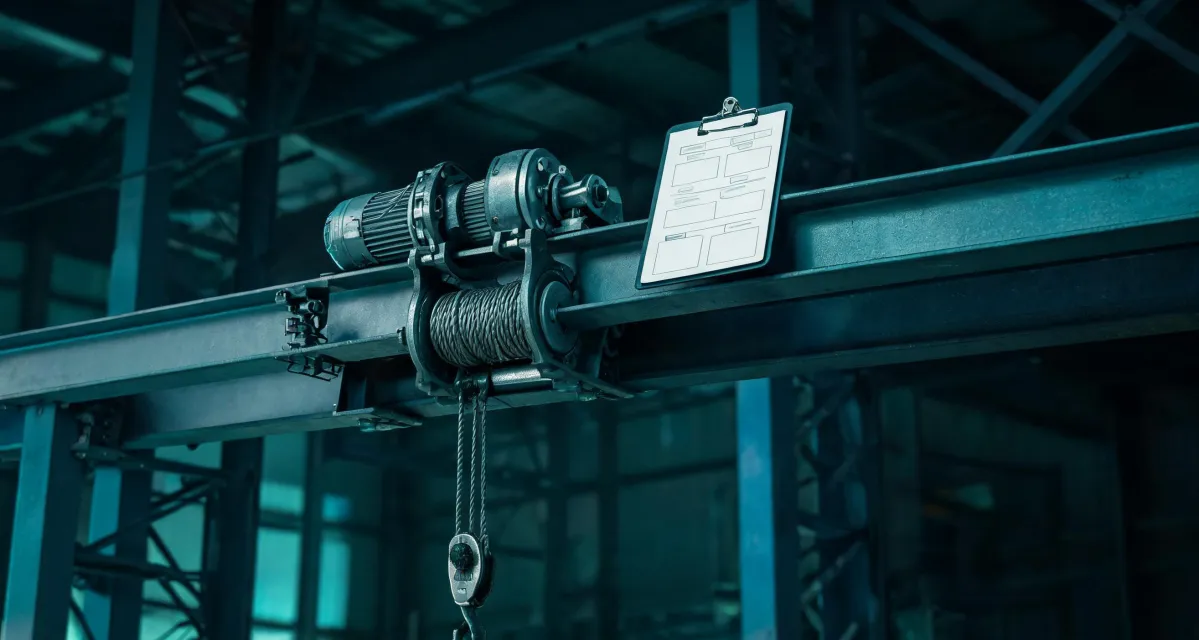
The low-headroom monorail trolley runs on monorail runways and single-girder overhead traveling cranes. The trolley adjusts for different beam sizes and comes standard with a two-speed trolley. Its published span is 1–15 tons.
The standard-headroom monorail trolley is built narrow on purpose, for small clearances, and is also used on monorail runways and single-girder overhead traveling cranes. Its published span is 20–30 tons.
The top-running double-girder unit is the compact one: minimal hook approach and headroom dimensions, with a flexible design that keeps all four wheels in contact with the girder. Published span is 1–55 tons.
The base mount is not a trolley at all. It is stationary hoisting or towing equipment, used in systems manufacturing among other places, with rope lead-off angle, hoist mounting and motor mounting position all adjustable as needed. Published span is 1–55 tons.
Two of those travel on a runway, one runs on a double-girder arrangement, one does not travel. That question splits the list in half before anybody mentions a load.
Headroom and Hook Approach Come First
If the hook cannot drop to the pick point and come back up with the load inside the space between the beam and the floor, then every tonnage figure on that sheet describes a machine that cannot make the lift in your building, and the quote is decoration. Capacity comes later.
The geometry language in the brochure does the elimination work for you. The low-headroom trolley exists specifically for reduced headroom on runways and single-girder cranes. The standard-headroom trolley is narrow because small clearances demand it. The double-girder unit is described as extremely compact with minimal hook approach and headroom. Three different answers to the same physical question: how much room does the machine eat above the hook?
Set a wide beam, a tight clearance over the hook path and a runway that is already bolted in place in front of those three lines, and the reading eliminates almost everything. A trolley that cannot sit on your beam or cannot fit the clearance has no tonnage that fixes it. Everything else drops out.
So ask for headroom and hook approach per arrangement, before capacity. A supplier who replies with a tonnage has answered a question you did not ask.
Where the Monorail Ladder Breaks
The two monorail trolleys do not share a range. The low-headroom unit is published at 1–15 tons, the standard-headroom unit at 20–30 tons. Read literally, the brochure states no monorail coverage between 15 and 20 tons, and nothing in the captured text explains the gap — whether it comes from headroom, from the trolley frame or from something else is not stated.
For a load in that middle band, treat the monorail route as unconfirmed. Do not assume the 20–30 ton span carries downward, and do not assume the two headroom variants are the same trolley with a different nameplate. If your load lands there, ask which arrangement applies and get the answer against the specific model, in writing. The trade-off is time: one more round of email against specifying a trolley nobody ever published.
Beam Fit and the Two-Speed Trolley
One line in the low-headroom description carries real procurement weight: the trolley is easily adjustable for different beam sizes and comes standard with a two-speed trolley. Adjustability is what lets one trolley sit under more than one beam section, which matters in a building where the runway gets modified or where the beam size is still unconfirmed at quote time. Two-speed as standard matters in a bay where positioning accuracy sets the cycle time.
The limit is scope. That sentence is written about the low-headroom monorail trolley and nothing else in the captured material. Do not carry the two-speed standard or the beam adjustability across to the standard-headroom trolley or the double-girder unit without written confirmation, because an option list is not a family trait. Name the trade-off plainly: adjustability buys coverage across beam sections, and it costs a fit check every time the beam changes. If the beam is fixed and known, that flexibility is buying you nothing.
When a Base Mount Beats a Trolley
Base mounts get skipped in trolley conversations, then show up in the wrong place. The published description is narrow: stationary hoisting or towing, systems manufacturing given as the example, with rope lead-off angle, hoist mounting and motor mounting position adjustable as needed, at 1–55 tons.
The choice turns on travel path, not on capacity. If the load has to travel along a runway, the base mount's 55-ton ceiling means nothing to you, because the machine does not move; go with a trolley arrangement. If the load is lifted and held at one point, or pulled along a fixed line, the adjustable lead-off angle is the feature that earns its keep and the base mount is the pick. Skip it the moment the bay needs horizontal travel, whatever the tonnage line says. The trade-off is flexibility against fit: the trolley covers ground, the base mount covers a point, and no capacity number converts one into the other.
A Tight-Headroom Bay, Walked Through
Suppose an existing single-girder runway, a beam of unknown section, clearance above the hook path tighter than anyone would like, and a load sitting near the top of the low-headroom trolley's 1–15 ton span. This is a hypothetical, not a documented installation, and the point is to watch the conditions do the eliminating one at a time.
The double-girder unit looks attractive first: minimal hook approach and headroom, 1–55 tons, room to spare on the load. Then the runway gets in the way. It is a single-girder runway, and the double-girder unit is a top-running double-girder arrangement; your structure does not become a double-girder crane because the hoist on the drawing is compact. The narrow standard-headroom trolley appeals on clearance, and its published span starts at 20 tons, above the load. The low-headroom trolley holds on both counts — right runway type, right clearance family — but the load sits at its stated ceiling, which is exactly where a buyer should stop guessing.
The honest output of a tight bay is a confirmation question, not a confident pick: which arrangement covers this load on this runway, and what headroom and hook approach does that one arrangement publish? An answer with figures attached in one paragraph gives you something to compare. An answer that changes format halfway through is not an answer.
Run the Checks in This Order
The sequence matters more than the individual checks, because each step removes options instead of adding them. First, travel path: does the load move along a runway or sit at a point? That answer splits trolley from base mount and settles half the argument before capacity arrives.
Second, headroom and hook approach: which trolley family is geometrically possible in the space above the hook path? Third, beam: what section is the runway or girder, and is the trolley in question stated as adjustable for it? Fourth, load: compare the load against the published span of the one arrangement still standing.
Run those out of order and you land on the mistake this article opened with — a monorail span being weighed against a double-girder span, or a load figure driving the email thread while the hook approach quietly rules out the machine. If you find yourself comparing two numbers that came from two different arrangements, stop and go back to step one.
What to Confirm Before You Specify
Send these as written questions with the RFQ, because the brochure leaves each one open. Which arrangement is being quoted, and what is that arrangement's own stated capacity span? What headroom and hook approach figures apply to that arrangement rather than to the family? On that specific model, are the beam adjustment and the two-speed trolley standard or optional? If the load falls between the two published monorail spans, what covers it, and under which arrangement?
Add a document request: the operation and maintenance manual for the model being quoted, so your maintenance team reads it before the unit is ordered rather than after it is hanging over the aisle. What that manual requires before operation is the manual's business, not something to reconstruct from a sales sheet.
Today, before anything goes out the door: write down the arrangement name you are asking about, that arrangement's stated capacity span, and its headroom and hook approach, then put the confirmation questions to the supplier in writing. When the reply lands, check whether every number in it belongs to one arrangement. If it mixes ranges from two, the quote is not ready to compare — ask again.
Share this note with the buyer team that writes the next factory request.

Jane Smith
I’m Jane Smith, a senior content writer with over 15 years of experience in the packaging and printing industry. I specialize in writing about the latest trends, technologies, and best practices in packaging design, sustainability, and printing techniques. My goal is to help businesses understand complex printing processes and design solutions that enhance both product packaging and brand visibility.
Comment collection is not enabled. Use the inquiry form for procurement questions.