Procurement note
What a Wire Rope Hoist Supplier Documents on Parts and Support
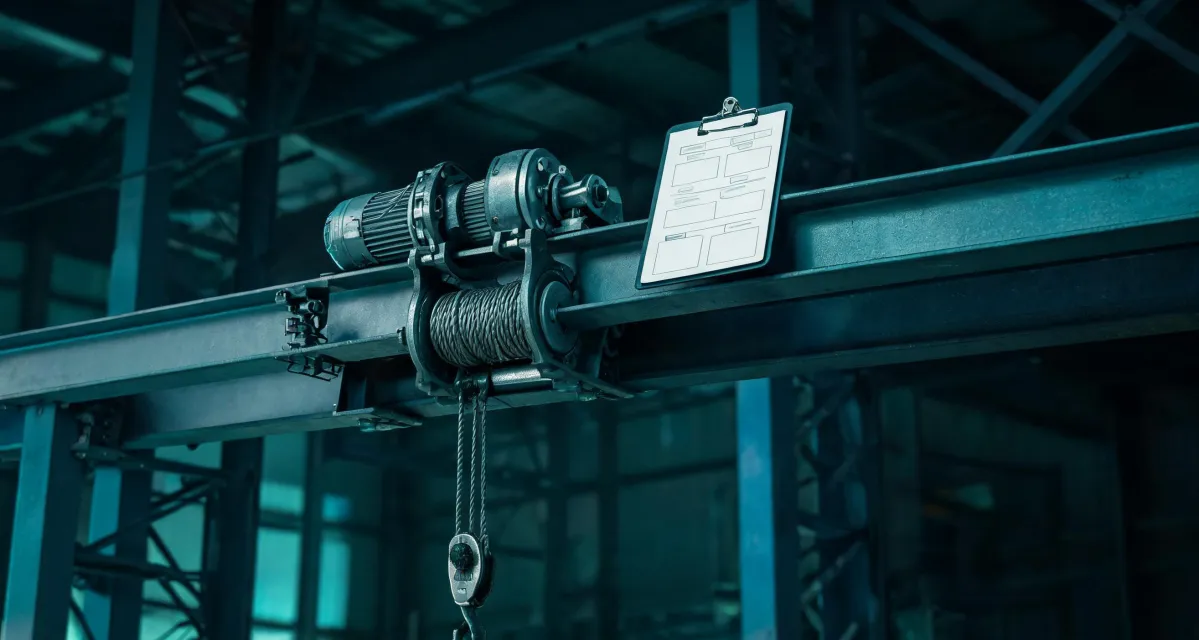
For a document about keeping hoists running, the Yale YK sales brochure is oddly precise about geography and oddly quiet about parts. It names the town your hoist ships from — Wadesboro, North Carolina — for units built with the most commonly requested options. Then the spare-parts line stays a level up: common spare parts are locally available, offered as the reason a product can be serviced quickly and downtime reduced. Everything below applies to that Yale YK OEM material only; these are product and service statements for one model line, not a survey of the hoist market.
Read those statements as a checklist of support channels rather than a parts catalog, and the questions worth putting to a supplier before a quote start to sort themselves into an order.
What Does a Hoist Supplier Document?
A supplier document is rarely one thing. Here it is four statements sitting side by side, each doing a different job, and reading them in sequence tells you more than reading any one of them alone.
First, support before, during and after the sale, delivered through application and product specialists, customer service teams and professional trainers. Second, local availability of the common spares, given as the mechanism behind quick service. Third, a network of authorized crane-builder partners through which lifting solutions are supplied. Fourth, shipment of YK hoists built with the most-requested options directly from the Wadesboro, North Carolina facility.
Now look for what is missing from that list: no item numbers, no stock quantities, no lead time against a named component. What the document puts in writing is a set of channels, a shipping origin and one general claim about local parts access. That is genuinely useful before a quote lands, because it separates the questions the supplier has already answered on paper from the ones you still have to ask.
So what does a document like this actually promise, and how far does that promise sit from what a parts seller gives you?
How Is Yale YK Different From a Parts Seller?
A catalog-only seller is easy to read. You name a part, they come back with a SKU, a price and whether it is on the shelf. Ask that seller who supports the hoist when the application turns out to be wrong for the duty cycle, and the conversation has nowhere to go.
The Yale YK statements answer the second question and leave the first open. Their proof is organizational — specialists, service teams, trainers, builder partners — rather than an inventory list. That difference is real, and it is not a ranking in either direction. A supplier can hold deep local parts stock with no published support structure, or staff a strong support organization on top of thin local stock. Nothing in this brochure tells you which of those you are buying from.
Suppose a warehouse is replacing a hoist on a runway whose trolley framing was reworked five years ago. The application specialist is the named role that would catch a fit problem before the order, and the crane-builder partner is the named channel that would handle the interface with the structure. For that buyer, those two channels are worth more than a price on a brake disc. For a straight replacement in kind on an unchanged runway, the reverse is usually true.
Which of those two answers does the documentation actually define well enough to rely on?
What Does 'Local Availability' Actually Promise?
Here the wording deserves a hard look, because the whole sentence is the claim: local availability of common spare parts means products can be serviced quickly, which helps reduce downtime. That is all it says. It does not name the parts, does not say how many are held, does not identify which local location, and does not give a response window.
So what does common cover? On a wire rope hoist the word usually points at the wear and service items a maintenance team touches most often, but the brochure draws no line, and you should not draw one on its behalf. That line moves with configuration. A different trolley arrangement, control package or duty requirement changes which parts matter, and common in the supplier's stocking plan may not match common in your own failure history.
What follows is narrow enough to get a real answer: which components, for this exact configuration, are actually held nearby? An answer that stays at the category level is still information — it places the claim in the support channel, not in the inventory.
If that is the parts side, what does the support side put a name to?
What Application Support Does Yale YK Name?
Pre-sale support is the easiest part of a brochure to skim past, and it is where two of the named roles sit. Application and product specialists work closest to the fit decision — duty requirement, lift height, trolley configuration, control method. Customer service is named as the responsive channel, the route for order status, documentation and the questions that surface between quote and delivery. Professional trainers are named separately from both, which points at operator readiness rather than equipment selection.
Crane-builder partners form a fourth channel and a different kind of one. That channel sits between the hoist and the structure it runs on, which matters when the runway, the building steel or the interface details are part of the job rather than a given.
What none of this supplies is a number. No response time, no training content, no service-level commitment, no statement about who covers what when a specialist visit is needed. That is less a flaw in the material than the edge of what a sales brochure can settle. Treat every named role as a channel you can ask to be written into the purchase documents, and ask what each one delivers against your commissioning date.
Why Does Local Parts Access Matter to Uptime?
Downtime is measured in stopped shifts, not in purchase orders.
The chain the brochure describes is simple enough to follow. Components are chosen for safety and longevity, which is presented as the route to minimal downtime and a low total cost of ownership; quick service made possible by nearby spares is then the second link. Follow it through and the value to a maintenance team is not a longer feature list but a shorter unscheduled stop. A part that has to be ordered in and a part held close by fix the same hoist; only one of them keeps the shift on schedule, and the gap lands on whoever has to explain the lost hours. No figure sits behind any of it — no downtime estimate, no response window, no savings — so read the chain as directional rather than measured.
Directional, though, is not the same as empty.
Which Support Claim Should You Check First?
Before you sign, ask one question and insist the answer arrives as a list: for the exact model and options on the quote, which spare parts are covered by local availability, and where are they held?
It is the right single check because it is where the most operationally useful sentence in the documentation meets its own limit. Local parts access is what a maintenance planner leans on the night a hoist goes down, and it is the line with the least definition behind it. Notice that the same brochure ties shipping to a stated set of popular build options — a boundary showing that configuration is what these statements attach to. If the answer comes back matched to your model and options, you can treat the support language as operational and plan around it. If it comes back as common parts, you now know what to stock yourself and what to leave to the supplier, and that decision belongs in your spares budget rather than in the brochure.
Share this note with the buyer team that writes the next factory request.

Jane Smith
I’m Jane Smith, a senior content writer with over 15 years of experience in the packaging and printing industry. I specialize in writing about the latest trends, technologies, and best practices in packaging design, sustainability, and printing techniques. My goal is to help businesses understand complex printing processes and design solutions that enhance both product packaging and brand visibility.
Comment collection is not enabled. Use the inquiry form for procurement questions.